
We’ve all been there: that awkward moment when you’re face-to-face with a local, unsure whether to shake hands, bow, or go for a cheek kiss. To navigate these tricky waters, try these seven fail-safe strategies: research cultural customs, learn key phrases, observe local body language, practice appropriate gestures, respect personal space, adapt to age and gender norms, and embrace flexibility. It’s like a dance, really – sometimes you’ll step on toes, but with practice, you’ll be gliding through greetings like a pro. Remember, a genuine smile is universal, so flash those pearly whites and get ready for some cultural calisthenics. The adventure’s just beginning!
Key Takeaways
- Learn basic local greeting phrases to show respect and effort in understanding the culture.
- Observe and mimic the body language of locals, including handshakes, bows, or cheek kisses.
- Respect personal space boundaries, which vary widely across cultures.
- Adapt to age and gender norms, as they significantly influence greeting customs in many societies.
- Remain flexible and open-minded, as greeting practices can differ even within the same country.
Research Cultural Greeting Customs
Before starting your global adventures, it’s important to research cultural greeting customs. We’ve all been there, awkwardly fumbling through a first encounter in a new country. But fear not! With a little homework, we can greet people like pros and show respect upon arrival.
From the classic handshake to the intimate cheek kiss, every culture has its own way of saying hello. In Japan, we’ll perfect our bow, while in New Zealand, we might press noses in a hongi.
Remember, what’s normal at home might be a faux pas abroad. In Cambodia, we’ll keep our hands off heads, and in China, we’ll opt for a lighter grip.
Learn Key Phrases and Words

Let’s start our language journey by mastering essential greetings and farewells in the local tongue.
We’ll also tackle basic numbers and phrases, like “please” and “thank you,” which can be real lifesavers when maneuvering through a new culture.
Essential Greetings and Farewells
Mastering essential greetings and farewells in a country’s native language can greatly enhance your travel experience.
We’ve found that a simple “hello” or “goodbye” goes a long way in breaking down cultural barriers. In Latin America, don’t be surprised if you’re greeted with a warm cheek kiss – it’s a sign of friendship!
Japan’s deep bows show respect, while India’s “Namaste” is a universal gesture of goodwill.
Arabic countries often combine handshakes with cheek kisses, starting with the right hand. And in Thailand, the “Wai” greeting is a beautiful way to show respect.
Remember, these customs aren’t just formalities; they’re windows into the soul of a culture.
Numbers and Basic Phrases
A handful of key phrases and numbers can make a world of difference when interacting with locals abroad.
We’ve found that learning to say “hello” and “thank you” in the local language instantly breaks down barriers. In Spain, a cheerful “Hola” and “Gracias” go a long way, while in France, “Bonjour” and “Merci” work wonders.
Don’t forget about numbers! Being able to count from one to five can be a lifesaver when haggling at markets or giving directions.
And remember, common greetings vary worldwide. In Russia, a firm handshake‘s the way to go, but in Japan, you’ll want to master the art of bowing.
By showing respect through these simple efforts, we’ve experienced warmer receptions and deeper connections with people everywhere we’ve traveled.
It’s amazing how a few words can open so many doors!
Polite Expressions Matter
Building on the importance of basic phrases, learning polite expressions in the local language can transform your travel experience.
We’ve found that greeting involves more than just saying “hello.” Traditional greetings often include a show of respect that’s unique to each culture. In Latin America, we start our day with a cheerful “buenos días,” while in Japan, we bow slightly and say “Konnichiwa.”
These polite expressions aren’t just words; they’re keys that reveal genuine connections. In Arabic-speaking countries, we’ve seen faces light up when we use “As-salamu alaykum,” and in India, a simple “Namaste” with joined hands speaks volumes.
It’s amazing how these small gestures can bridge cultural gaps and make us feel like we belong. So, let’s embrace these local customs and watch our travels become richer and more meaningful!
Observe Local Body Language

Observing local body language can be a game-changer when greeting people in different cultures.
We’ve all been there – going in for a handshake when a bow was expected, or accidentally invading someone’s personal space. It’s like a dance, and we need to learn the steps!
In Asia, a slight bow might be the way to go, while in Latin America, cheek kisses are the norm. But how many kisses? That’s where observation comes in handy!
Eye contact rules vary too – what’s polite in one place might be rude in another.
And don’t get us started on personal space! In the Middle East, close is comfortable, but North Americans like their bubble.
Practice Appropriate Gestures

Gestures speak louder than words when it comes to international greetings.
We’ve got to master the art of shaking hands with our right hand in the Middle East, while bowing in Japan shows respect.
Let’s not forget the intimate hongi in New Zealand or the cheek kisses in Latin America. It’s a wild world of hellos out there!
To truly connect with locals, we need to embrace their customs:
- Use the right hand for handshakes in the Middle East
- Bow deeply in Japan to show extra respect
- Go for hugs and kisses in Latin America, but count them carefully
- Stick out your tongue in Tibet (yes, really!) to show you come in peace
Respect Personal Space Boundaries

Every culture has its own invisible bubble of personal space, and respecting these boundaries is essential for positive interactions.
We’ve all been there, feeling like the reincarnation of a cruel space invader when we accidentally stand too close to someone abroad. In North America, we’re used to keeping an arm’s length, but in Mediterranean countries, people might cozy up closer.
Don’t be surprised if your firm handshake is met with a softer gesture in some Asian cultures. And in Arab countries, the rules change based on gender.
Before you extend a hand or go in for a hug, take a moment to observe the locals. Watch how they greet each other and maintain distance.
Adapt to Age and Gender Norms

When we’re greeting locals around the world, we’ve got to remember that age and gender can play a big role in how we say hello.
In many cultures, it’s essential to show extra respect to elders, often using specific titles or gestures like bowing or hand-to-forehead touches.
We’ll also need to be mindful of gender-specific protocols, like how in some Arab countries, men might hug each other while women greet similarly, but there’s usually less physical contact between men and women.
Respect Hierarchical Greetings
Adapting to hierarchical greetings can make or break your interactions abroad. We’ve all been there, feeling like fish out of water when trying to navigate unfamiliar social norms.
But fear not! By respecting age and status, we can master the art of greeting like a local. Remember, in many cultures, younger people show deference to elders through specific gestures. Men and women often greet differently too, with some cultures favoring cheek kisses or handshakes.
To nail those hierarchical greetings, keep these tips in mind:
- Observe locals and mimic their actions
- When in doubt, err on the side of formality
- Learn a few key phrases in the local language
- Be open to physical contact, but respect boundaries
Gender-Specific Protocols Matter
Gender’s invisible hand shapes greeting customs worldwide, making it essential to adapt to both age and gender norms when interacting abroad.
We’ve all been there: that awkward moment when you’re not sure whether to offer a handshake, go for a hug, or attempt a cheek kissing ritual. In Japan, we might bow deeper to show respect to elders, while in Arab countries, men might greet each other with warm hugs and kisses on the right cheek.
But don’t try that with the opposite gender there! In India, we might see younger folks touching the feet of elders, a practice that varies by gender.
And in Latin America, we’ll need to master the art of cheek kissing between women and mixed genders, but stick to handshakes between men. It’s a dance of cultural nuances!
Embrace Flexibility in Interactions
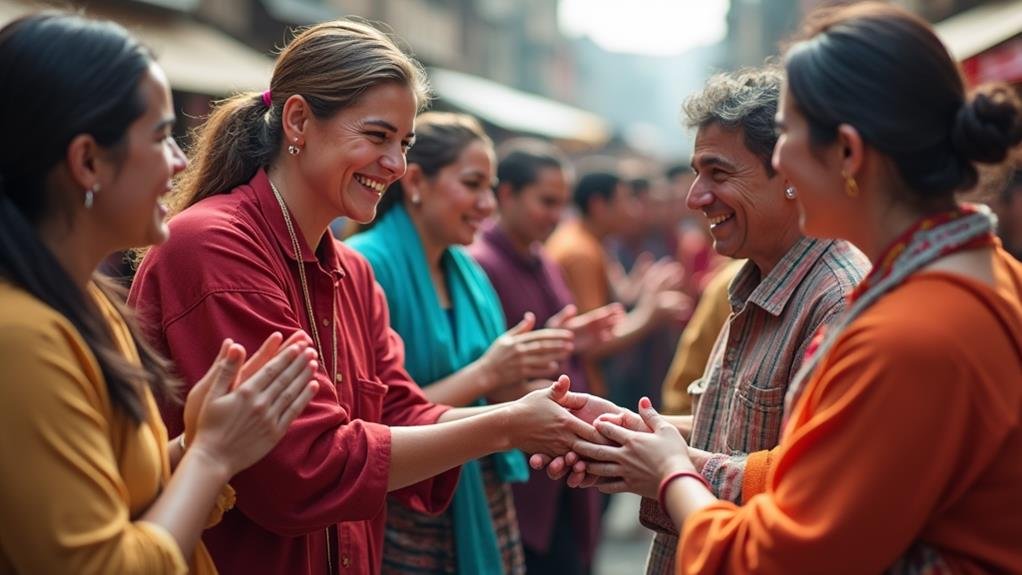
When it comes to greeting locals worldwide, we’ve got to embrace flexibility in our interactions.
Even within a single country, customs can vary wildly. That’s why it’s essential to adapt our approach based on local norms.
Here’s how we can navigate this freedom-loving adventure:
- Observe how locals greet each other
- Ask for guidance on proper greetings
- Be open to different levels of physical contact
- Use the right hand when appropriate, especially in Middle Eastern cultures
Frequently Asked Questions
How to Greet a Global Audience?
Let’s embrace cultural nuances, master body language, and make lasting first impressions. We’ll navigate regional variations with respect and openness. By adapting our greetings, we’ll break barriers and connect authentically, fostering global understanding and celebrating our shared humanity.
How Do People Greet Each Other Around the World?
We’ve got a world full of unique greetings! From traditional handshakes to cultural customs, we’re all about expressing ourselves. Let’s embrace the importance of body language and regional phrases as we connect across borders, freely and authentically.
What Is the Best Greeting in the World?
Like a tapestry of human connection, the world’s best greeting isn’t universal. We’re free to embrace cultural significance, regional variations, and historical context. Let’s celebrate the diversity of verbal and non-verbal greetings that make our interactions unique.
How Do You Greet Someone in a Unique Way?
Let’s embrace cultural gestures and regional customs! We can explore unique greetings by learning language variations and greeting etiquette worldwide. From tongue-sticking to nose-pressing, there’s a world of expressive ways to connect with others and break free from convention.
Conclusion
We’ve covered a lot of ground in our journey through global greetings. Remember, when in Rome, do as the Romans do! By embracing these tips, we’ll not only avoid awkward faux pas but also forge genuine connections with locals. Our travels become richer, more meaningful, and downright fun when we make the effort to greet people properly. So let’s step out of our comfort zones, put these strategies into practice, and watch as doors (and hearts) open worldwide!


 By
By
 By
By

 By
By